


 English

Blog

2025-12-18 15:06:17
The resistance of a copper bus bar is a key electrical parameter that directly affects current-carrying capacity, heat generation, and overall system efficiency. Because copper has very low electrical resistivity, copper busbars are widely used in high-current power distribution, battery systems, and industrial equipment.
Understanding how resistance works in different busbar designs—such as Flexible Copper Busbar, Solid Copper Busbar, and Insulated Copper Busbar—helps engineers select the optimal solution for demanding applications.
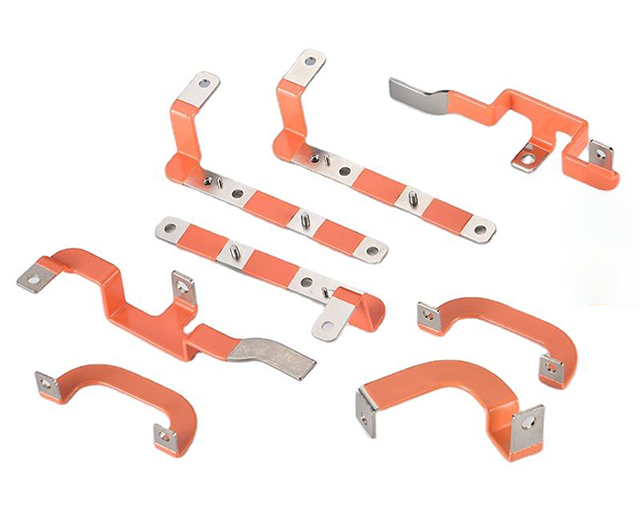
The resistance of a Copper Busbar depends on three main factors:
Material resistivity of copper
Length of the busbar
Cross-sectional area
The standard formula is:
R=ρ×AL
Where:
R = resistance (Ω)
ρ = resistivity of copper (1.68 × 10⁻⁸ Ω·m at 20°C)
L = length (m)
A = cross-sectional area (m²)
Because copper has low resistivity, even long or high-current copper busbars typically exhibit resistance measured in micro-ohms per meter.
A Solid Copper Busbar is a rigid conductor with a fixed cross-section. Its resistance is:
Predictable and stable
Very low due to high material density
Ideal for fixed, high-current installations
Solid designs are commonly used in power distribution panels, switchgear, and high-current copper busbar assemblies.
A Flexible Copper Busbar is made of laminated copper foils or braided copper layers. Although its structure differs from solid designs, its electrical resistance remains very low because:
Multiple parallel copper layers reduce effective resistance
Current is evenly distributed across layers
Flexible designs are widely used in battery systems and vibration-sensitive applications.
An Insulated Copper Busbar has the same electrical resistance as a bare busbar of the same dimensions. Insulation affects safety and spacing, not conductivity.
Common insulation types include:
PVC Insulated Copper Busbar
Epoxy Insulated Copper Busbar
These options allow compact installation while maintaining low resistance and high current capacity.
A Copper Busbar Connector plays a critical role in overall system resistance. Poor connection quality can significantly increase contact resistance.
A Copper Busbar Connector Custom design ensures:
Maximum contact surface area
Low contact resistance
Reliable performance in high-current applications
Precision-engineered connectors are essential for maintaining the low resistance advantage of copper busbars.
Proper Copper Busbar Fabrication processes—such as precision cutting, punching, bending, and surface treatment—help maintain:
Consistent cross-section
Smooth contact surfaces
Low electrical resistance
Copper Busbar Customization allows designers to optimize:
Length and cross-section
Connector layout
Insulation type
Custom designs reduce resistance losses and improve system efficiency.
In High-Current Copper Busbar Assemblies, minimizing resistance is critical to:
Reduce heat generation
Prevent voltage drop
Improve long-term reliability
Copper’s low resistivity makes it the preferred material for extreme current demands.
A Nickel Copper Busbar features a nickel-plated surface. While plating slightly increases surface resistance, it:
Improves corrosion resistance
Enhances durability
Maintains stable electrical performance over time
This makes nickel-plated copper busbars ideal for harsh or humid environments.
Low resistance in a copper busbar results in:
Higher energy efficiency
Lower operating temperature
Reduced power loss
Improved electrical safety
These benefits explain why copper busbars dominate modern high-current electrical systems.
So, what is the resistance of a copper bus bar?
It is extremely low—typically measured in micro-ohms per meter—and depends on the busbar’s length, cross-section, and fabrication quality.
Whether using a Solid Copper Busbar, Flexible Copper Busbar, Insulated Copper Busbar, or High-Current Copper Busbar Assemblies, copper remains the optimal choice for efficient and reliable power distribution.
With proper Copper Busbar Fabrication and Customization, designers can achieve minimal resistance and maximum system performance.

Copyright © 2026 G AND N FORTUNE LIMITED All rights reserved.